
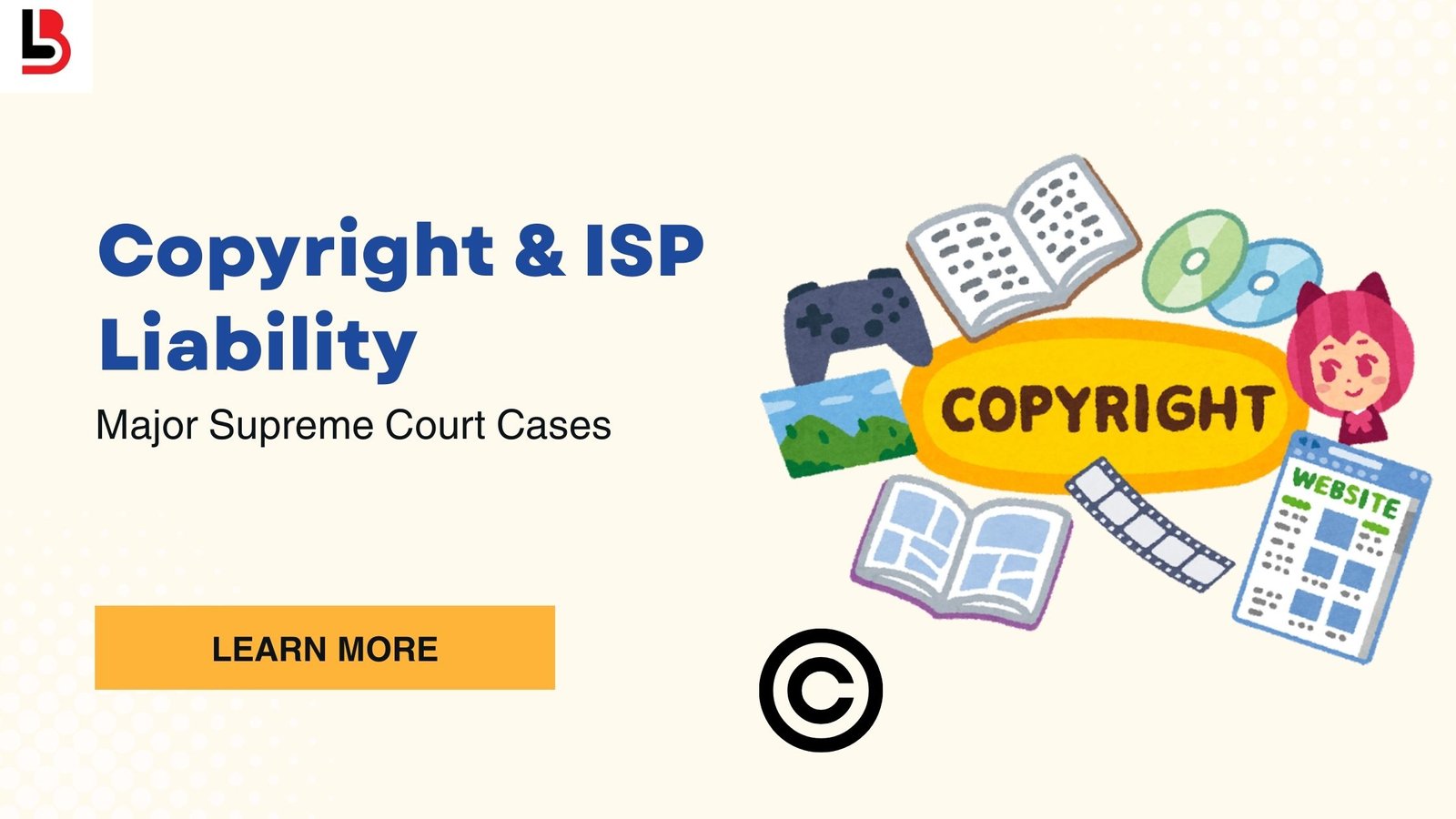
The internet has fundamentally transformed how creative works are distributed, consumed, and monetized. At the center of this transformation lies a persistent legal tension: how far should copyright law extend to hold intermediaries especially Internet Service Providers (ISPs) and technology platforms liable for infringement committed by their users?
The U.S. Supreme Court has played a critical role in shaping this balance. While Congress addressed many issues through the Digital Millennium Copyright Act (DMCA), the Court’s decisions have defined the boundaries of secondary liability, clarified when technology providers cross the line from neutral intermediaries to infringers, and influenced how lower courts evaluate ISP responsibility.
This article examines the major Supreme Court cases that define copyright liability in the digital age, tracing how the Court has navigated innovation, user behavior, and copyright protection.
Understanding ISP and Intermediary Liability
Copyright law traditionally targets direct infringers—those who reproduce, distribute, or publicly perform copyrighted works without authorization. ISPs and platforms rarely engage in these acts themselves. Instead, they face claims of secondary liability, primarily in two forms:
-
Contributory infringement: knowingly inducing or materially contributing to infringement
-
Vicarious infringement: profiting from infringement while having the ability to control it
The Supreme Court’s decisions in this area predate the modern internet but remain foundational to how courts analyze ISP liability today.
Sony Corp. of America v. Universal City Studios (1984)
The Betamax Case
Why it matters: This is the cornerstone case for technology-provider liability.
In Sony v. Universal, movie studios sued Sony for selling the Betamax video recorder, arguing that consumers used it to record copyrighted television programs. The studios claimed Sony was contributorily liable for enabling infringement.
The Supreme Court disagreed.
Key Holding
The Court ruled that a technology provider is not liable for contributory copyright infringement if the product is capable of “substantial non-infringing uses.”
Time-shifting—recording TV programs to watch later—was deemed a fair use. Because the Betamax had legitimate purposes, Sony could not be held responsible for how consumers used it.
Impact on ISP Liability
Although decided before the internet era, Sony established a powerful shield for technology companies:
-
Innovation should not be stifled merely because a tool can be misused
-
Liability depends on intent and design, not just downstream infringement
This “substantial non-infringing use” doctrine later became the legal foundation for defending search engines, hosting services, and peer-to-peer technologies.
MGM Studios Inc. v. Grokster, Ltd. (2005)
Inducement and the Limits of Sony
Why it matters: Grokster refined—and limited—the protection offered by Sony.
Grokster and StreamCast distributed peer-to-peer file-sharing software widely used for copyright infringement. Unlike Sony, these companies marketed their products to former Napster users and relied on infringing activity for ad revenue.
Key Holding
The Supreme Court held that a company can be liable for copyright infringement if it intentionally induces users to infringe, even if the technology is capable of lawful use.
The Court emphasized evidence of:
-
Marketing aimed at infringers
-
Failure to implement meaningful anti-infringement measures
-
A business model dependent on infringement
Impact on ISPs and Platforms
Grokster clarified that neutrality matters. ISPs and platforms are generally protected when they act as passive conduits, but they risk liability when they:
-
Encourage infringement
-
Design systems to profit from unlawful use
-
Turn a blind eye to rampant infringement
This inducement theory continues to influence cases against platforms accused of facilitating piracy.
American Broadcasting Companies, Inc. v. Aereo, Inc. (2014)
When Technology Looks Too Much Like a Broadcaster
Why it matters: Aereo addressed whether a tech platform could avoid liability by using clever technical design.
Aereo offered subscribers the ability to stream live television over the internet using thousands of tiny, individual antennas—one per user. Aereo argued that each transmission was a private performance, not a public one, and therefore did not infringe copyright.
The Supreme Court rejected that argument.
Key Holding
The Court ruled that Aereo publicly performed copyrighted works without authorization, making it directly liable for infringement.
The majority focused on functional equivalence, concluding that Aereo operated “just like” a cable television provider.
Implications for ISPs
While the Court insisted its ruling was narrow, Aereo raised concerns across the tech industry:
-
Technical architecture alone cannot shield a service from liability
-
Courts may look beyond formal design to economic reality
-
Services that closely resemble traditional copyright-regulated industries face higher scrutiny
Importantly, the Court emphasized that traditional ISPs, cloud storage providers, and passive intermediaries were not the target of its ruling.
Google LLC v. Oracle America, Inc. (2021)
Fair Use and Functional Copying
Why it matters: While not an ISP liability case per se, Google v. Oracle significantly affects how courts evaluate copying in technology platforms.
The case centered on Google’s use of Java API declarations in Android. Oracle claimed infringement; Google argued fair use.
Key Holding
The Supreme Court held that Google’s use of the API declarations was fair use, emphasizing:
-
The functional nature of the copied material
-
The transformative purpose of enabling new platforms
-
The broader public benefit of interoperability
Relevance to Intermediaries
The decision reinforces judicial sensitivity to:
-
Software functionality versus expressive content
-
The importance of innovation and compatibility
-
Avoiding copyright interpretations that hinder technological progress
For ISPs and platforms, Google v. Oracle signals continued judicial caution against overextending copyright into technical infrastructure.
The DMCA and the Supreme Court’s Shadow
Although the Supreme Court has never directly interpreted DMCA §512 safe harbors, its rulings influence how lower courts apply them.
Under the DMCA, ISPs are shielded from liability if they:
-
Act as passive intermediaries
-
Respond expeditiously to takedown notices
-
Lack actual or “red flag” knowledge of infringement
Cases like Sony and Grokster inform how courts assess:
-
Knowledge
-
Intent
-
Willful blindness
The Supreme Court’s emphasis on neutrality and inducement aligns closely with DMCA principles.
Themes Across Supreme Court Jurisprudence
Several consistent themes emerge from the Court’s copyright decisions:
1. Innovation Should Not Be Punished
The Court repeatedly warns against legal rules that chill technological development.
2. Intent Matters
Neutral tools are protected; deliberate encouragement of infringement is not.
3. Function Over Formalism
Courts may look beyond technical design to real-world impact and business models.
4. Balance Is Essential
Copyright protection must coexist with free expression, competition, and technological progress.
Conclusion: The Supreme Court’s Careful Middle Path
The Supreme Court has not made ISPs copyright police, nor has it granted them blanket immunity. Instead, it has charted a measured middle course, protecting legitimate innovation while holding bad-faith actors accountable.
From Sony’s embrace of lawful uses, through Grokster’s inducement doctrine, to Aereo’s functional analysis, the Court’s decisions continue to shape the digital ecosystem. As new technologies—from AI-generated content to decentralized networks—raise fresh questions, these precedents will remain central to the evolving debate over copyright and intermediary liability.
In the digital age, the Supreme Court’s message is clear: copyright law must adapt—but it must do so without sacrificing the engines of innovation that define the modern internet.

Trying my hand at 399jl.info. The graphics are pretty good. Hope the payouts are just as good! Give it a shot: 399jl